Bioacoustics · Nine interface languages
Instruments and software for wildlife research.
We build the recorders, cameras and analysis tools that turn field observation into evidence — across the full acoustic spectrum, and at prices researchers can actually pay.
Four products on one platform · AURA in use by researchers today
Blyth’s horseshoe bat Rhinolophus lepidus
Constant frequency 99.4 kHz, measured across four calls · 384 kHz, 32-bit float
2048-pt Hann · 70–110 kHz shown · Recorded and analysed on our own tools
Why we exist
The tools were never built for the people doing the fieldwork.
The instruments and software wildlife researchers depend on are priced for institutions rather than for the people in the field, and built around a narrow set of taxa rather than the range a working survey actually encounters. A team surveying one site may record bats, birds, frogs and insects in a single night, then need four different tools and four different licences to make sense of it.
That gap is not abstract to us. Two decades of work in bioacoustics, ecological survey and wildlife conservation taught us what researchers outside the best-funded institutions are up against: instruments that cost more than an entire project budget, software that assumes reliable power and connectivity, and reference material built around someone else’s continent.
So we build both halves. The instrument that makes the recording and the software that reads it, designed together, sharing one account and one data model — and specified from field requirements rather than from a product roadmap.
Working range
One company across the whole spectrum.
Incumbents specialise in a single taxon or a single frequency band. Everything we build works across all of them, because a field team surveying one site does too.
0.1–20 Hz20 Hz–20 kHz20–90 kHz90–500 kHzWhat we build
Four products, one platform.
Every product shares the same account, project and observation model, so a deployment logged in the field carries through to analysis and export without re-entry. One of them is in researchers’ hands today; the other three are in build.
AURA
Bioacoustics analysis workstation. Spectrogram analysis, detection, per-call measurement and species reference libraries, infrasound to ultrasonic
In use · betaEcoForge
Field data collection on phone and tablet. Offline capture and schema-driven surveys that arrive in AURA already structured
In developmentChiroCount
Automated bat emergence counting from thermal and infrared video, for roost monitoring and impact assessment
In developmentDhvani
Passive acoustic recorder for long unattended deployments, with on-device detection and standards-compliant metadata
In developmentEvidence
Six recordings, from 40 hertz to 172 kilohertz.
Our own recordings, analysed with our own tools. Every spectrogram below was computed from a real file, not drawn, and every caption states the analysis parameters — because a figure without them cannot be checked.

Grey slender loris Loris lydekkerianus
An ultrasonic whistle. A primate holding a near-pure tone at 75 kHz — close to four octaves above the top of human hearing, and audible to no one present when it was made.
Peak frequency 75.01 kHz, stable within 0.7 kHz · Duration 168 ms
Bandwidth 488 Hz at −20 dB · SNR 59.8 dB
Recorded 500 kHz, 16-bit · FFT 8192-pt Hann, 16.4 ms
Source rescued individual, recorded at night undisturbed

Durga Das’s leaf-nosed bat Hipposideros durgadasi
A constant-frequency plateau closed by a steep downward sweep — among the highest frequencies recorded from any Indian bat, and an Indian endemic. A 256 kHz recorder would not capture it at all.
Peak frequency 172.3 kHz across three calls (172.1–172.5) · SNR to 64.6 dB
Bandwidth 938 Hz at −20 dB · Recorded 384 kHz, 16-bit
Shown 110–182 kHz over 0.30 s · FFT 1024-pt Hann, 2.7 ms
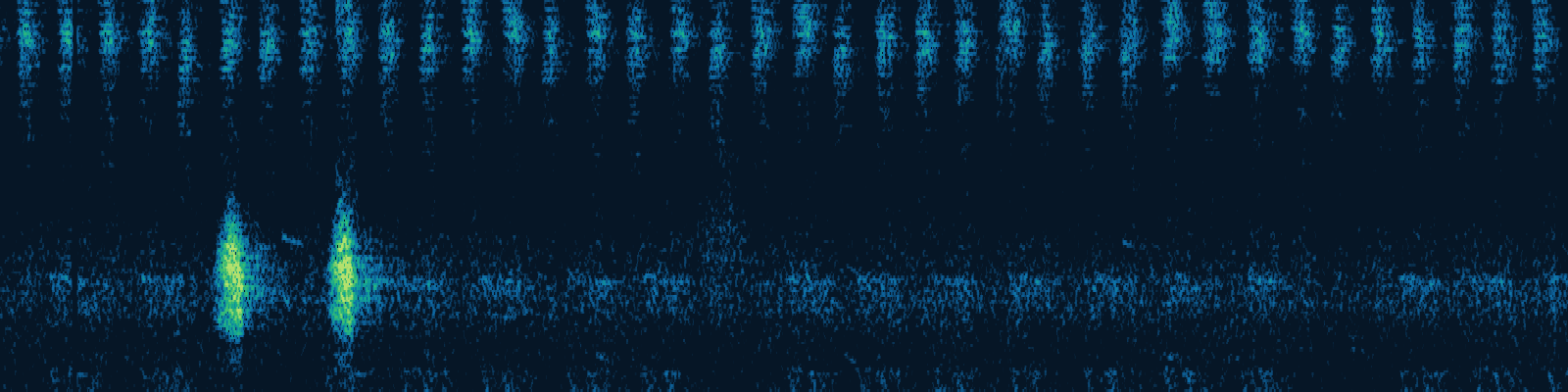
Cricket Orthoptera, species undetermined
Stridulation. The dominant energy sits above 20 kHz — above the top of adult human hearing, so this insect is calling loudly in a band nobody standing there would hear.
Dominant frequency 22.78 kHz, 31.8 dB above noise · Energy to 41 kHz
An audible component at 7.13 kHz is weaker than the ultrasonic cluster
Recorded 384 kHz, 16-bit · FFT 2048-pt Hann, 5.3 ms
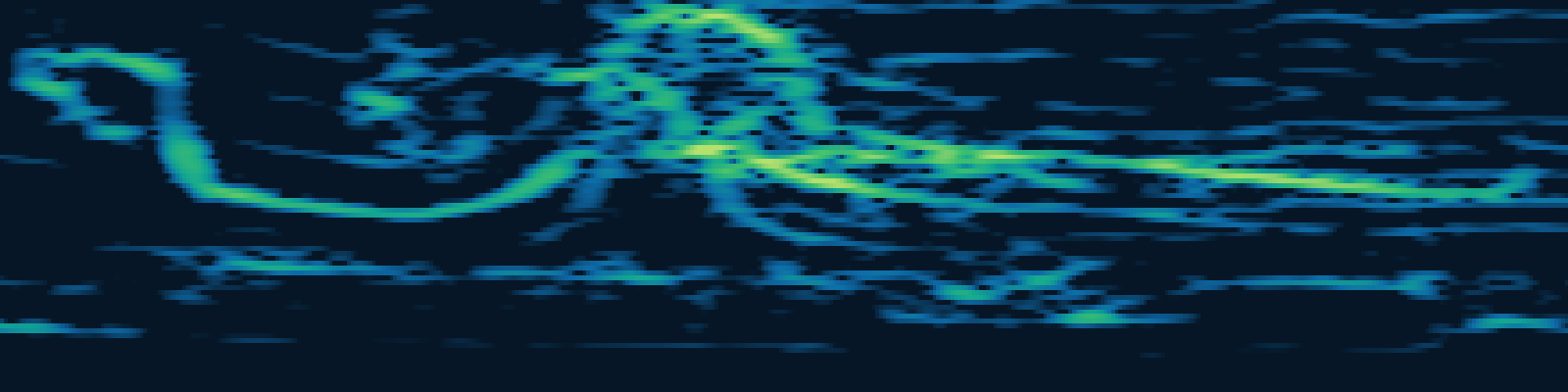
Asian elephant Elephas maximus
Rumble. The parallel sweeping contours are a harmonic series moving together as the call is modulated.
Energy concentrated 40–120 Hz, peak near 70 Hz
Shown 15–230 Hz over 8 s · FFT 16384-pt Hann, 371 ms
Source video audio track, 44.1 kHz — the infrasonic fundamental below 20 Hz is not recoverable from this recording
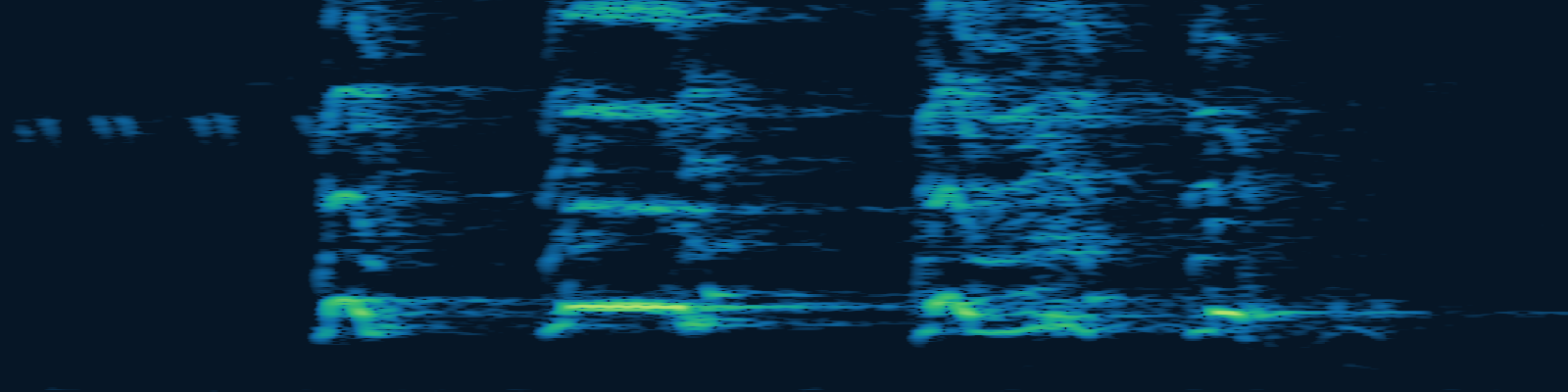
Grey junglefowl Gallus sonneratii
Crow. Three notes, each a harmonic stack built on a low fundamental, against a continuous insect chorus.
Shown 0.2–6 kHz over 1.9 s · FFT 2048-pt Hann, 46 ms
Source video audio track, 44.1 kHz
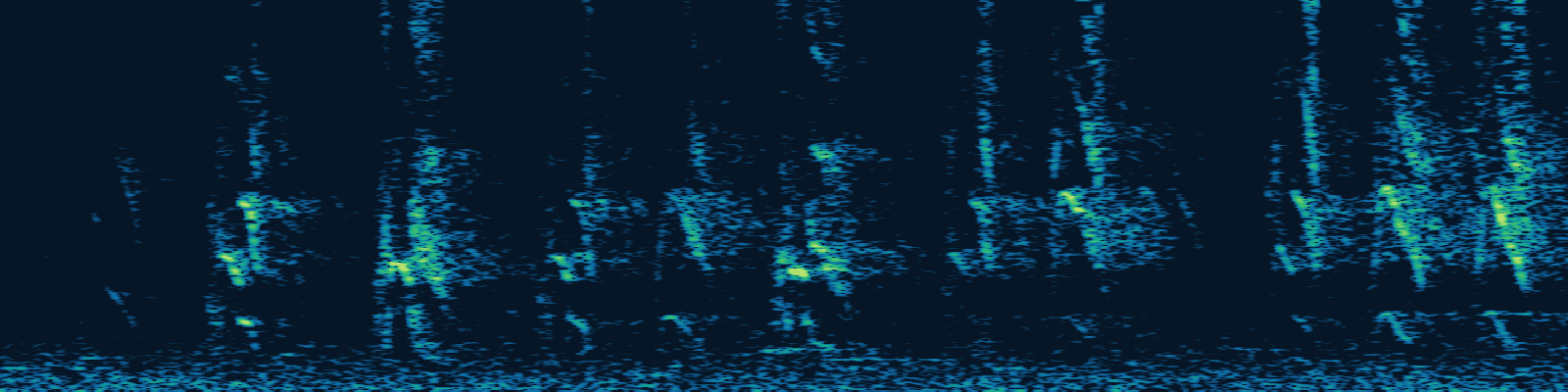
Rose-ringed parakeet Psittacula krameri
Flock calls. Harsh, broadband and repeated — energy spread across many harmonics rather than concentrated in a tone.
Shown 0.9–8 kHz over 4 s · FFT 2048-pt Hann, 46 ms
Source video audio track, 44.1 kHz
Shipping today
AURA — the analysis half, in use now.
Browser-based, so there is nothing to install and no admin rights needed. Analysis runs on your own machine — recordings are not uploaded in order to be processed, which matters for protected species, community land and permit conditions.
Analysis Measurement
- Spectrogram in 2D and 3D, with power spectrum, oscillogram and zero-crossing views
- Per-call measurements — peak, start and end frequency, bandwidth, duration, slope, harmonics
- Eight per-taxon parameter sets; switch taxon and the workspace reconfigures
Reference Species
- Over 1,000 bird species against an 11,000-entry global checklist
- 128 South Asian bats with frequency ranges, call shapes and IUCN status
- Marine mammals, amphibians, primates and insects, plus your own libraries
Privacy By default
- One-click redaction of a recording that captured human speech
- Coordinate suppression on export for threatened species and community land
- Grid rounding to GBIF guidance, never random displacement
Output Export
- Publication figures at 600 DPI with millimetre sizing
- Raven selection tables, CSV, Excel and JSON for R or Python
- Nine interface languages, shipping today
That is a quarter of what it does. The full capability list runs to ten groups, covering viewing, detection, audio editing, review and inter-rater reliability, project management and support.
How we work
Your data stays yours, in formats other tools can read.
We treat open standards as a requirement across every product. Nothing we build should make it harder to move elsewhere, publish to a data commons, or hand a dataset to a collaborator using different software.
The company
Built by people who do the fieldwork.
Wild Synapse Private Limited is a private company limited by shares, incorporated in India under the Companies Act, 2013, and based in Bengaluru, Karnataka. We are recognised as a startup by DPIIT and registered as a micro enterprise under Udyam.
Products are specified from field requirements, tested in the field by working researchers, and priced so that a funded project and an unfunded student can both use them. The Basic tier is free, anywhere in the world, for students, independent researchers and non-commercial study. We charge for Professional, where the advanced capabilities sit and where the budget does too.
We design for the conditions fieldwork is actually done in — intermittent power, no connectivity, long deployments, and data that may be sensitive because of the species or the community it was recorded near. Those are not edge cases in this work. They are the normal case.